What is an Indigenous foods challenge?
It is to harvest, preserve, hunt, gather, and trade food to last a full winter. September 2009 at a B.C. Foods Systems Network conference in Chehalis, in between the workshops a couple of ladies and I got to talking. Raven Ann Potchka and Dawn Marsden. What if we were to eat what our ancestors did and do it all ourselves... could we do it? We decided to take the winter of 2009 to research what is actually Indigenous and what has been introduced. To spend the spring and summer gathering and to make it a challenge to encourage others to join in and create a food sharing network as well.
This has been a challenge indeed!
NOT ALLOWED
Dairy This has proven very hard for the kids so we have allowed organic almond milk without sugar
ssugar maple syrup and local honey are allowable substitutes
white flour though we are using local milled oats and whole grain local milled bread and papa John made us pumpernickel with molasses
processed foods or meats
shopping in the larger Foods stores and chains
fast food
pop or juice
beef, pork, and chicken
Allowable
local honey
local fruits and vegetables though the first day was hard my daughter loves bananas and grapes so we make sure its organic and at the local health food store
eggs this one we are still up in the air about
beans we were unable to get a hold of some real indigenous beans form down south so we use local organic
Herbs and spices try to be local and organic
organic Lemons
organic local garlic and ginger
some farmers market items such as vinegar, mustard and homemade preserves without sugar
Restaurants must only eat organic local fruits or veggies and seafood if we have to eat out
* once a month we will treat ourselves to one introduced food for the day
The Kids
Almond milk
birthday cake at a birthday party
organic corn chips
sherbet at coombs country market
Special days at school
We can trade throughout North and South America... its all Indigenous land. Foods that were here prior to contact. Such as corn and beans from the south, wild rice form the east, caribou way up north,eulichan grease, seaweed and herring eggs from the north west coast. We will use the trading system as much as possible. However, some people prefer money and this can be allowed.
So during the summer of 2010 we have harvested, hunted, traded and preserved the following foods:
Moose - roasts, dried (big chief smoker we got secondhand), canned moose stew 1 1/2 cases
My cousin Travis shot a moose and we drove 1150km to Fort St. John, we traded for 3 cases of sockeye salmon, halibut, and dried candied salmon. 2 Moose hearts traded by my cousin Sai from the Northwest Territories for 1 case of salmon
Deer - roasts, ribs, 6 jars of stew with homemade tomato sauce
This deer my husband shot. This was the first time my children seen an animal die, they prayed and thanked the deer for its life and put the stomach wrapped in sword ferns and let the tide take it out
Rock cod - frozen
John and the kids went to Seitcher Bay on the west coast and caught the fish
Clams and Crabs -frozen
Kids and John got this but we ate most of this during the summer months
rabbit - local farmers market
Salmon - 35 frozen given to me by Jane Jones from local Tseshaht First Nations, and by cousin Tyrone Marshall caught down the river beside our house, 1 case jarred fish head soup from said fish, 25 1/2 smoked and 13 cases of canned sockeye salmon, My sister Skeena and I went to the mainland and stayed with our beloved friends June and Fred Quipp from the Cheam First Nations who donated the fish and home to stay in while we spent a few days under her awesome canning shelter. She taught me how to smoke and hang my first smoked salmon. This was our main trade item so we are down a few cases I think we still have 8 cases and canned 10 of the 1/2 smoked salmon so we are down to 15 and up 2 cases of canned smoked, 1 bag of full smoked and 10 dried and candied salmon bought from local Tseshaht Ray Watts
Seaweed bought a few bags from a friend Barb White in Comox. I wish I had more.
Eulichan grease my cousin Sacheen told be of a guy named Jacob on facebook who was selling and he sent me 5 500mls cans of the good stuff
Sea asparagus - 1 1/2 cases of pickled picked by John on the west coast
Bull kelp - 2 cases of pickled also picked by John on the open water of the westcoast
Berries - frozen local blueberries we picked at a u-pick with the kids, frozen and jarred blackberries we picked with the kids, wild cranberries a gift from my friend Snookie from northwest territories traded for canned salmon
Fruit - a huge bag of dried, 1 case jarred and made into leather local apples bought at the farmers market, peaches 1/2 case done with honey as a sweetener and my friend Mahalia Young gave me a case, cherries Mahalia gave me a case, frozen grapes and pureed frozen for juice picked in our parents backyard, couple of jarred pears from last year we got at our old house
Mushrooms - dried chantrelle John and kids picked
Other - 1 case canned stewed tomatoes, 4 cases of salsa all local organic from the farmers market,
wild rice we got at the local health food store, oats and grain bread which we will buy every week at the farmers market, squash and lots of fresh veggies from the farmers market. I did not have time this summer to start my garden. I am a novice gardener but very keen to try. Whole grain flour locally milled only if we really need it, vinegar local guy makes it as well as cleaning products
Coffee - farmers market fair trade coffee I know this one I could not give up would've have liked to trade with Indigenous farmers instead
Chestnuts - four bags of frozen chestnuts from our yard in our old house
Now hopefully this will last us the winter but we will continue to go to the west coast to harvest shellfish like oysters, clams, and crab throughout the winter season, and we will go to the farmers market every week if we need to get things like potatoes and onions.
We have weighed ourselves (not telling yet) and are going to get a full physical to monitor our health during this time. I am also 7 months pregnant so I don't intend on losing any weight, if I stay the same that would be ideal. My 10 year old daughter is also writing a journal of her indigenous food challenge and her feeling about having dried moose meat and berries for lunch at school. The kids are getting a big kick out of the challenge and we talk about our food at the dinner table. My four year old says "is this indigenous mom" then at the health food store he says "can I have a ndignous sucker?"
I have only done it for 2 days now and I feel so good knowing exactly where all my food was made and how it was prepared. Lots of love went into the preparing of our food and you feel it when you eat it.
We are a big family of we have 5 kids as well my sister is staying here with her 2 boys and my 19 year old nephew. So all together we have 4 adults and 7 kids in our household. Today for dinner we had a huge baked moose bone with salad and crispy seaweed and to wash it all down with ice tea.
Some of the challenges so far is my freezer was unplugged for a day a thawed out the top part of the freezer so I had to quickly can up the meat. The berries I have to make a sauce now that its all mushy.
Until my next entry
eat good and live well
"Our food is our medicine"
Nitanis, John and Family
Reviving Traditional Food Practises
Reviving Traditional Food Practises
Tuesday, November 16, 2010


Monday, September 20, 2010
Indigenous Food Challenge
DAY ONE
Sunday, November 14, 2010
“World Diabetes Day”
Today is the first day of the Indigenous Food Challenge. We have decided to commence our challenge on this date to commemorate the loss of a wonderful person that was taken early from our lives through diabetes. Victor Reece was a master carver and storyteller from the Tsimpshian Nation. More than this Victor was a loving father and grandfather.
We are all too aware of the alarming rates of diabetes among First Nations Peoples. A colonial lifestyle has brought with it a colonial diet for our people. Our once active practices of harvesting and preserving indigenous foods have given way to a sedentary, over-indulgence of unhealthy foods. Many of the foods that have become ‘traditional’ to our people (bannock, fry bread, homemade white bread, etc) are main staples within the common indigenous household. It is this normalization of introduced foods that has weakened our immunity and made us more susceptible to diseases and obesity.
Traditionally, our people maintained a spiritual connection with the land and the food systems therein. Our harvesting practices were gentle upon the earth and in return we received plentiful amounts of nutritious and nourishing foods. The ability to feast or to share food in great quantities took much effort and our families cherished this opportunity. The sharing of food has always been an important part of our culture. In many First Nations communities this cultural value has not changed… but the food has.
Go to a feast today and you will quickly realize this change of diet. Turkey, Roast Beef, Spaghetti, bread, potatoes, and a wide assortment of sugary desserts have replaced the hand-picked local foods. Similarly, the average First Nations family’s cupboards are now filled with canned, processed foods, and products high in starch, sugar and salt rather than fresh and preserved foods from the local area. This change of the palette has happened very quickly throughout First Nations communities.
During the 1950’s and 60’s, shortly after World War II had provided a higher military presence along the western coast of Canada, bulk shipments of food were transported to First Nations reserves where First Nations peoples were now confined to small parcels of land and could not travel with the migrating herds of caribou, moose, salmon and buffalo, or travel to the summer villages for the harvesting season. The common belief during this time was that First Nations peoples were poor and undernourished because the majority of their food sources originated directly from the surrounding land and sea. As an act of compassion food was shipped in to First Nations reserves. These donated foods included: canned pork, sugar, flour, and other food items that could be transported and preserved for long durations of time. Needless to say these foods were a stark contrast to the high-protein diet that had been evident among our people for countless generations. As a result, the diet and lifestyle of our people changed seemingly overnight. Compound this with the damaging effects of the residential school experience, crippling laws that inhibited traditional lifestyles and alcoholism and you have a recipe for disaster.
Today, we are surrounded and continuously bombarded with a barrage of unhealthy, fast and convenient foods. Our berry picking songs erased from our memories and replaced with TV jingles… “ba-da ba-da-da, I’m loving it.” Pop, chips and chocolate bars have become the most common trade items among our people. Our people have been very resilient. We have survived smallpox, measles, influenza, whooping cough, tuberculosis but we are not yet through this onslaught of disease. Today, we are confronted with disproportionate rates of cancer, arthritis, heart disease and most of all diabetes!
As a family we recognize that action must be taken. Every member of my family is genetically predisposed to diabetes. As a First Nations man my life expectancy is the lowest in the country. The disease has become intergenerational through my wife and my maternal and paternal lineages. Never before has a disease permeated so deeply into our way of life. In an effort to combat this assault upon our health we seek to draw strength from our ancestral ways. We appreciate the medicinal aspects of our indigenous foods and aim to use these foods as a way out of this position.
Over the past several months we prepared ourselves for this challenge. Although we maintained a consistently unhealthy diet we harvested and preserved a wide assortment of indigenous foods. These foods include: deer, moose, salmon, cod, shellfish, sea asparagus, bull kelp, eulichan grease, seaweed, frozen and dried fruit and berries, and locally grown vegetables. We have canned, frozen, smoked and dried many of these foods to preserve them for the winter season. Our plan is to engage in a strictly indigenous diet for four months beginning on November 14th 2010 and ending on March 14th 2011. Throughout this challenge we will monitor our weight, blood pressure, and heart rate as well as psychological, emotional and spiritual self-assessments. The diet we will follow will primarily consist of indigenous foods harvested locally and/or in other regions by indigenous sources. We have allowed ourselves to include locally produced fruits and vegetables throughout this challenge and also locally milled oats and similar products found at the local farmers market.
We appreciate that there will be some obstacles encountered throughout this challenge. As a family of eight we are constantly dealing with an assortment of issues around food. School snacks and lunches (our children went to school with a snack of dried moose meat and dried apples, they were surrounded by the other students willing to trade their chocolate and juice boxes for a piece) this will require more effort on our behalf, extended family dinners and celebrations, the winter holidays, and out of town business trips are all areas that we anticipate the biggest challenges. And of course we will have to deal with withdrawal from certain ingredients that are no longer in our diet – sugar, dairy, flour, and chocolate to name a few. Also, during this challenge we will be welcoming a new addition. We feel that the challenge will not necessarily be an easy one but the rewards will be amazing!
John Rampanen, Nitanis Desjarlais and family
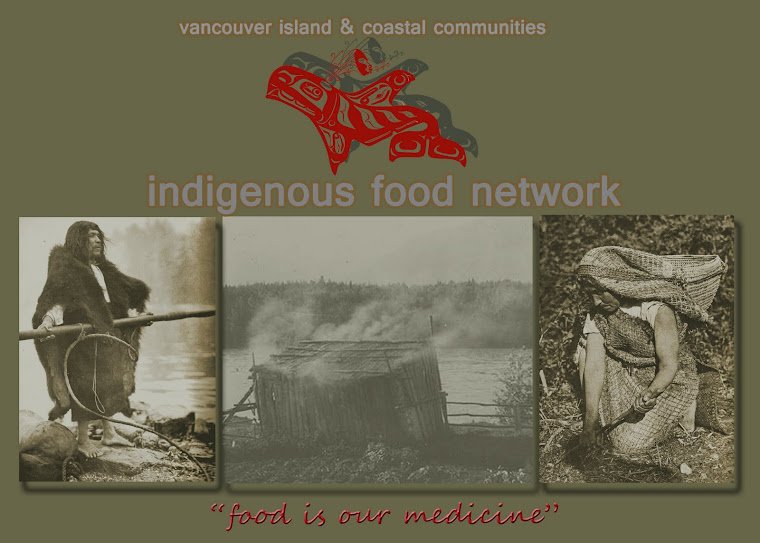
Also Victor Reece did the logo for Vancouver Island and Coastal Communities Indigenous Foods Network
It was one of his last designs before he got too sick.
Whale in its natural elements represents the top of the food chain. The face emerging from the blow hole represents the humans who use the resources the same as the whale. The copper colour represents the wealth amongst the West Coast People. The eye of the Whale is a Salmon, Trout head and it depicts the beginning of life, as we know it today, of the ocean. The shadow of the Killer Whale represents the passing of information from one generation to the next. The shadow represents the ancestors, whose knowledge and wisdom we honour.
Sunday, November 14, 2010
“World Diabetes Day”
Today is the first day of the Indigenous Food Challenge. We have decided to commence our challenge on this date to commemorate the loss of a wonderful person that was taken early from our lives through diabetes. Victor Reece was a master carver and storyteller from the Tsimpshian Nation. More than this Victor was a loving father and grandfather.
We are all too aware of the alarming rates of diabetes among First Nations Peoples. A colonial lifestyle has brought with it a colonial diet for our people. Our once active practices of harvesting and preserving indigenous foods have given way to a sedentary, over-indulgence of unhealthy foods. Many of the foods that have become ‘traditional’ to our people (bannock, fry bread, homemade white bread, etc) are main staples within the common indigenous household. It is this normalization of introduced foods that has weakened our immunity and made us more susceptible to diseases and obesity.
Traditionally, our people maintained a spiritual connection with the land and the food systems therein. Our harvesting practices were gentle upon the earth and in return we received plentiful amounts of nutritious and nourishing foods. The ability to feast or to share food in great quantities took much effort and our families cherished this opportunity. The sharing of food has always been an important part of our culture. In many First Nations communities this cultural value has not changed… but the food has.
Go to a feast today and you will quickly realize this change of diet. Turkey, Roast Beef, Spaghetti, bread, potatoes, and a wide assortment of sugary desserts have replaced the hand-picked local foods. Similarly, the average First Nations family’s cupboards are now filled with canned, processed foods, and products high in starch, sugar and salt rather than fresh and preserved foods from the local area. This change of the palette has happened very quickly throughout First Nations communities.
During the 1950’s and 60’s, shortly after World War II had provided a higher military presence along the western coast of Canada, bulk shipments of food were transported to First Nations reserves where First Nations peoples were now confined to small parcels of land and could not travel with the migrating herds of caribou, moose, salmon and buffalo, or travel to the summer villages for the harvesting season. The common belief during this time was that First Nations peoples were poor and undernourished because the majority of their food sources originated directly from the surrounding land and sea. As an act of compassion food was shipped in to First Nations reserves. These donated foods included: canned pork, sugar, flour, and other food items that could be transported and preserved for long durations of time. Needless to say these foods were a stark contrast to the high-protein diet that had been evident among our people for countless generations. As a result, the diet and lifestyle of our people changed seemingly overnight. Compound this with the damaging effects of the residential school experience, crippling laws that inhibited traditional lifestyles and alcoholism and you have a recipe for disaster.
Today, we are surrounded and continuously bombarded with a barrage of unhealthy, fast and convenient foods. Our berry picking songs erased from our memories and replaced with TV jingles… “ba-da ba-da-da, I’m loving it.” Pop, chips and chocolate bars have become the most common trade items among our people. Our people have been very resilient. We have survived smallpox, measles, influenza, whooping cough, tuberculosis but we are not yet through this onslaught of disease. Today, we are confronted with disproportionate rates of cancer, arthritis, heart disease and most of all diabetes!
As a family we recognize that action must be taken. Every member of my family is genetically predisposed to diabetes. As a First Nations man my life expectancy is the lowest in the country. The disease has become intergenerational through my wife and my maternal and paternal lineages. Never before has a disease permeated so deeply into our way of life. In an effort to combat this assault upon our health we seek to draw strength from our ancestral ways. We appreciate the medicinal aspects of our indigenous foods and aim to use these foods as a way out of this position.
Over the past several months we prepared ourselves for this challenge. Although we maintained a consistently unhealthy diet we harvested and preserved a wide assortment of indigenous foods. These foods include: deer, moose, salmon, cod, shellfish, sea asparagus, bull kelp, eulichan grease, seaweed, frozen and dried fruit and berries, and locally grown vegetables. We have canned, frozen, smoked and dried many of these foods to preserve them for the winter season. Our plan is to engage in a strictly indigenous diet for four months beginning on November 14th 2010 and ending on March 14th 2011. Throughout this challenge we will monitor our weight, blood pressure, and heart rate as well as psychological, emotional and spiritual self-assessments. The diet we will follow will primarily consist of indigenous foods harvested locally and/or in other regions by indigenous sources. We have allowed ourselves to include locally produced fruits and vegetables throughout this challenge and also locally milled oats and similar products found at the local farmers market.
We appreciate that there will be some obstacles encountered throughout this challenge. As a family of eight we are constantly dealing with an assortment of issues around food. School snacks and lunches (our children went to school with a snack of dried moose meat and dried apples, they were surrounded by the other students willing to trade their chocolate and juice boxes for a piece) this will require more effort on our behalf, extended family dinners and celebrations, the winter holidays, and out of town business trips are all areas that we anticipate the biggest challenges. And of course we will have to deal with withdrawal from certain ingredients that are no longer in our diet – sugar, dairy, flour, and chocolate to name a few. Also, during this challenge we will be welcoming a new addition. We feel that the challenge will not necessarily be an easy one but the rewards will be amazing!
John Rampanen, Nitanis Desjarlais and family
Also Victor Reece did the logo for Vancouver Island and Coastal Communities Indigenous Foods Network
It was one of his last designs before he got too sick.
Whale in its natural elements represents the top of the food chain. The face emerging from the blow hole represents the humans who use the resources the same as the whale. The copper colour represents the wealth amongst the West Coast People. The eye of the Whale is a Salmon, Trout head and it depicts the beginning of life, as we know it today, of the ocean. The shadow of the Killer Whale represents the passing of information from one generation to the next. The shadow represents the ancestors, whose knowledge and wisdom we honour.
Friday, June 11, 2010


Deconstructing Dinner
Here is a link to an excellent interview with the Nushuk youth council at the International Ethnobiology conference 2010 the youth had also participated in the Digital Harvest project.
Wednesday, June 9, 2010
Regional meeting in Alert Bay

Alert Bay is inviting everyone to come and spend Aboriginal day with the community to celebrate
June 21st, 2010
Hosts: NI Food Security Network & ‘Namgis Traditional Foods Coordinator
We will meet in the morning (place to be determined) of the 21st to share information about community food initiatives, then do some planting of berry bushes and fruit trees in the CICG in the afternoon.
It would be nice if those who can make it would bring a plant donation for the Cormorant Island Community Garden & ‘Namgis Pre-natal Garden project!
Can those of you who will be attending the VICCIFN regional meeting in Alert
Bay, please RSVP by Wed., June16th. This will allow us time to plan for the
amount of food we will need to prepare! Thank you! Please send confirmation
to Sharon Gordon at kgordon@cablerocket.com
Check out this lovely video
Subscribe to:
Posts (Atom)